

Below the Humanitarian Minimum
Why some homelessness responses fall short of the standards used in refugee camps

There is a version of this conversation that makes people uncomfortable almost immediately, which is probably why it rarely gets stated this directly. In multiple parts of the United States and Canada, a person experiencing homelessness may have less guaranteed space, less access to sanitation, and less environmental safety than someone living in a refugee camp governed by international humanitarian standards. That is not a rhetorical flourish or a cheap comparison meant to provoke a reaction. It is a comparison that holds up when you examine the numbers, the design expectations, and the day-to-day conditions side by side. Once you see it clearly, it becomes very difficult to return to the idea that what we are currently doing represents the best we can offer under pressure to people experiencing homelessness.

What the UNHCR Actually Specifies
The UNHCR guidance is not abstract or aspirational. It is grounded, operational, and built from decades of experience managing displacement at scale under some of the most complex conditions imaginable. It assumes scarcity, rapid influx, cultural diversity, and instability, yet it still insists on structure because the absence of structure produces predictable harm. The standards are not designed to create comfort, but they are designed to prevent chaos from becoming the default operating condition.
For living space, the commonly cited minimum is 3.5 to 4.5 square metres per person (about 11.5 to 15 square feet). That amount of space is not generous, but it is intentional, and it reflects an understanding that human beings require a minimum physical boundary to function. Without that boundary, sleep deteriorates, tension rises, and even basic daily activities become more difficult. The standard does not eliminate hardship, but it reduces unnecessary friction in environments that are already strained.
Separation distances are also defined with precision and purpose. Structures are expected to be spaced at least 2 metres apart (about 6 feet), with designated firebreaks of approximately 30 metres every 300 metres (approximately 100 feet every 985 feet) in larger sites. These measurements are grounded in real-world experience with fire spread, density risks, and the cascading effects of poorly planned environments. They reflect an understanding that proximity, when unmanaged, can turn a difficult situation into a dangerous one very quickly.
Sanitation and water are treated as foundational, not optional. A widely used benchmark is one toilet for every 20 people, with facilities located within a reasonable walking distance and designed to be accessible and safe. Water access is similarly defined, often targeting, ensuring that basic hygiene and hydration needs can be met consistently. These are not ideal conditions, but they are a floor that prevents conditions from degrading into something far worse.
The layout itself is also intentional. Pathways, drainage, lighting, and service placement are all part of the design, not afterthoughts added once problems emerge. Visibility is considered. Movement is considered. Safety is engineered into the environment, even when the broader context remains unstable. None of this solves displacement, but it shapes how people experience displacement on a daily basis.
What We Normalize Instead
In many jurisdictions, we operate as though these standards are either irrelevant or unattainable, which would be more convincing if they were not already being applied in more complex and resource-constrained environments. Encampments form without spacing requirements, often with tents packed tightly together in ways that would violate even the most basic fire safety principles if they were indoors. There is rarely any enforced expectation about distance, layout, or density, even when the risks are obvious and recurring. This is true in both sanctioned and unsanctioned encampments.
Sanitation is inconsistent and frequently insufficient. It is not uncommon to see dozens or even hundreds of people relying on a handful of portable toilets, or none at all, which creates predictable public health concerns. Water access is often improvised, dependent on outreach teams, nearby businesses, or temporary solutions that can disappear without warning. These conditions are then reframed as behavioural or management challenges rather than environmental failures that were entirely foreseeable.
Shelters reflect many of the same issues in a different form. Beds are placed inches apart to maximize capacity, leaving little to no personal space. Storage is limited or nonexistent, forcing people into difficult decisions about what they can keep and what they must abandon. The environment communicates that throughput and efficiency take precedence over dignity, and then we expect people to regulate their behaviour within that environment as though it is neutral.
We should not be surprised when conflict emerges under these conditions. We have created environments that increase stress, reduce privacy, and amplify tension, then attribute the outcomes to the individuals within them rather than the design of the space itself. The result is a cycle where the environment contributes to instability, and that instability is used to justify maintaining the same environment.
What The UN Refugee Standards Can Teach Us About Shelter Standards
One of the more persistent assumptions in this space is that refugee camps and homelessness response systems serve fundamentally different populations in terms of complexity. That assumption begins to unravel the moment you examine who is actually being served in both contexts. Refugee camps are not composed of a single, uniform group of people with identical needs and circumstances. They include families, single adults, older adults, children, and individuals with disabilities. They include people managing chronic health conditions, mental health challenges, and the psychological impact of trauma and displacement. They include individuals navigating language barriers, cultural differences, and uncertain legal status, often all at the same time. In other words, they are environments defined by complexity rather than simplicity.
The same is true within homelessness response services, even if the drivers of that complexity differ. People experiencing homelessness often present with intersecting challenges related to health, mental health, substance use, income instability, and trauma. They are navigating fragmented systems, inconsistent supports, and environments that are often not designed to stabilize them. The complexity is not hypothetical. It is present in nearly every interaction.
The key difference is not the complexity of the people. It is the degree to which the environment is designed to account for that complexity. UNHCR standards assume complexity as a starting point and respond by reducing environmental stressors wherever possible. They recognize that density, lack of privacy, poor sanitation, and disorganized layouts will amplify tension regardless of who is present.
There is also a recognition that behaviour is shaped by environment. When people are placed in conditions that lack structure, predictability, and basic dignity, instability becomes more likely, not less. Conversely, when the environment is designed to reduce friction and support basic functioning, it becomes easier for people to engage with services, maintain stability, and navigate their circumstances.
These are lessons that translate directly to shelters and sanctioned encampments. They do not eliminate the need for housing solutions, nor do they resolve systemic drivers, but they fundamentally change the baseline conditions within which people are trying to survive. That alone has implications for safety, service delivery, and overall outcomes.
The Misdiagnosis We Keep Repeating
There is a persistent narrative that we lack standards for encampments or emergency shelter environments, as though we are navigating something too novel or too complex to define clearly. That narrative is convenient, but it does not hold up when examined against existing global practice. We are not operating in a vacuum of knowledge.
We have standards that have been tested, refined, and applied in some of the most challenging contexts in the world. The issue is not that guidance is unavailable. The issue is that it has not been adopted in a consistent or intentional way within many homelessness response services. Part of the hesitation is philosophical and political. There is concern that formalizing encampments with standards makes them more permanent or signals acceptance rather than urgency. There is a fear that improving conditions will reduce pressure to pursue long-term solutions, even though the absence of standards has not accelerated those solutions either.
What we are left with is a version of informal permanence without structure. Conditions persist, but without the safeguards that could make them safer and more humane. Ambiguity becomes the operating environment, and ambiguity tends to produce inconsistency, conflict, and uneven outcomes.
If You Sanction It, You Own the Standard
If a community chooses to sanction encampments, then the conversation shifts in a fundamental way. It is no longer about tolerating something that has emerged organically. It becomes a question of design, governance, and accountability.
At that point, minimum standards are not optional. They are the baseline for legitimacy.
That means ensuring 3.5 to 4.5 square metres per person, even when space is limited and demand is high. It means maintaining at least 2 metres of separation between structures, even if that reduces total capacity. It means providing one toilet per 20 people and 15 litres of water per person per day as a consistent standard, not an occasional achievement.
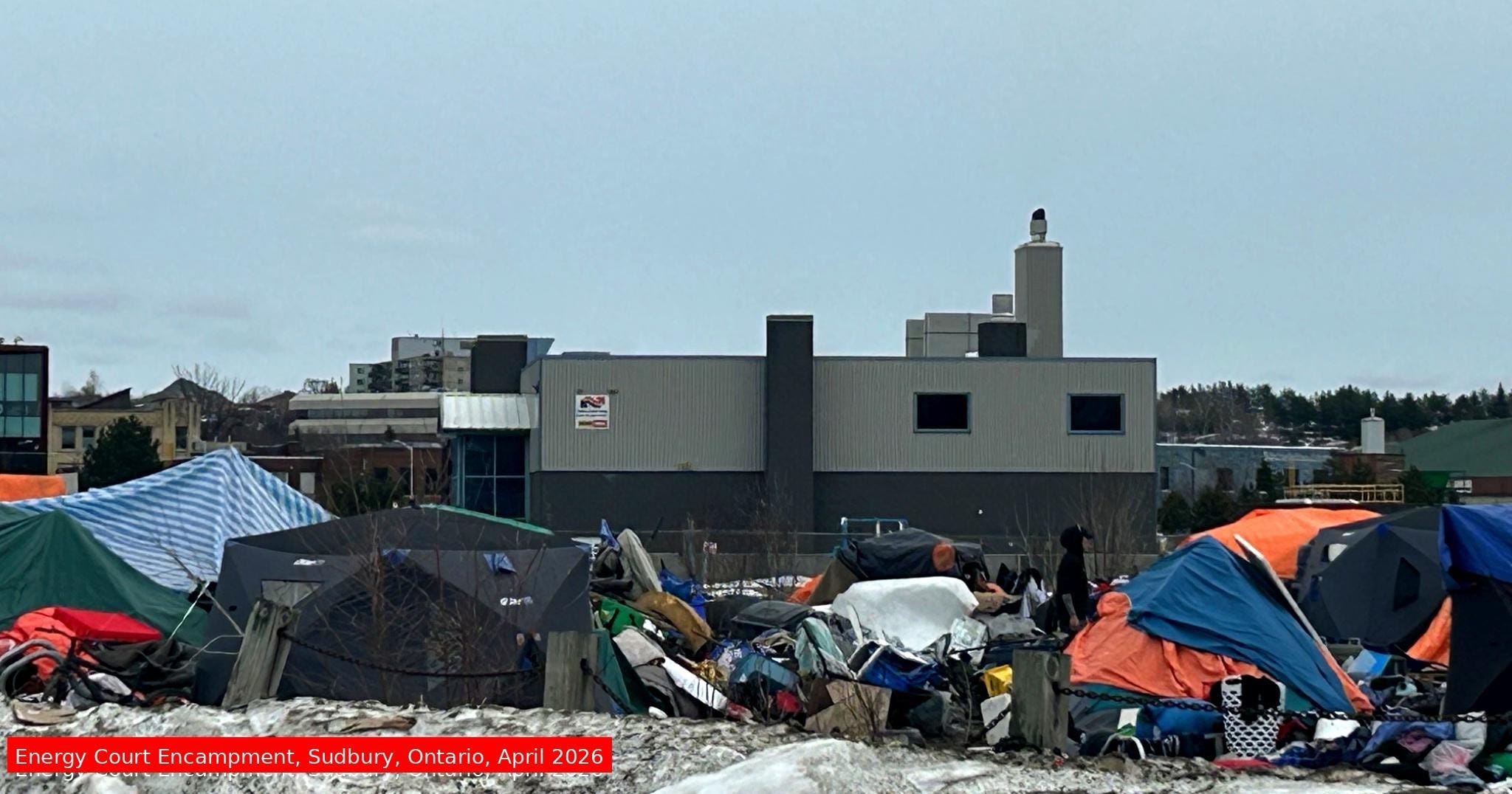
It also means designing the environment with intention. Pathways, lighting, drainage, and service placement should support safety and accessibility rather than undermine them. Outreach, healthcare, and housing navigation should be able to operate within a functional environment instead of compensating for a dysfunctional one.
Anything less is a decision. It is not an unavoidable limitation or an unfortunate byproduct of a difficult problem. It is a choice about what level of dignity we are willing to uphold when we formalize these spaces.
The Uncomfortable Comparison
Comparing UN refugee camp standards to encampments and homeless shelters forces a level of honesty that is often avoided. If refugee camp standards represent a reasonable minimum for human dignity under extreme conditions, then in many of our communities, we are operating below that minimum for people experiencing homelessness. That reality is difficult to reconcile with how we often describe our intentions.
It is not that we lack all resources, nor that the standards are unknown or untested. It is that we have normalized a lower bar over time and built systems around that normalization. The comparison exposes that gap in a way that is difficult to dismiss.
There are important differences between displacement due to conflict and homelessness driven by housing systems, income instability, and health challenges. Those differences matter for policy, prevention, and long-term solutions, and they should not be ignored. However, the immediate human needs do not change based on the cause of displacement.
The need for space, sanitation, safety, and basic environmental order remains constant. When those needs are not met, the consequences are predictable regardless of the context. That is the part of the comparison that carries the most weight.
A More Honest Baseline
The sector spends a great deal of time debating models, language, and philosophy, often with a level of intensity that suggests the right framework will resolve the underlying issues. Those debates are not without value, but they frequently operate at a level removed from the conditions people are experiencing in real time. The gap between discussion and lived experience can be significant.
Adopting a minimum standard grounded in UNHCR guidance would not solve homelessness. It would not create housing supply, resolve systemic inequities, or eliminate the pressures that are driving more people into homelessness. Those challenges require sustained, structural responses that go well beyond environmental design.
What it would do is establish a floor that is clear, defensible, and grounded in evidence. It would define the conditions that we are not willing to accept, even when solutions are incomplete. It would remove the ambiguity that currently allows vastly different conditions to coexist under the same system.
And if a community is prepared to sanction encampments, then it should also be prepared to meet that floor consistently and immediately. Not as an aspiration or a future goal, but as the minimum requirement for doing it at all, because anything less is not a gap in knowledge but a gap in will.